
Cosmonic has entered the Developer Preview phase and is now inviting users to deploy their ideas.
Cosmonic Blog


Mitigate Supply Chain Risk with WebAssembly
There is nothing more chaotic today than the current state of cybersecurity.
In my latest article in The New Stack, “How Web Assembly Can Mitigate the Software Supply Chain Crisis,” I discussed the relative ease with which today’s predominant method for building software allows for malware infection across all components of an application.
Until now, the method for building software relied on the aggregation of software components that often lack distinct security boundaries between them.

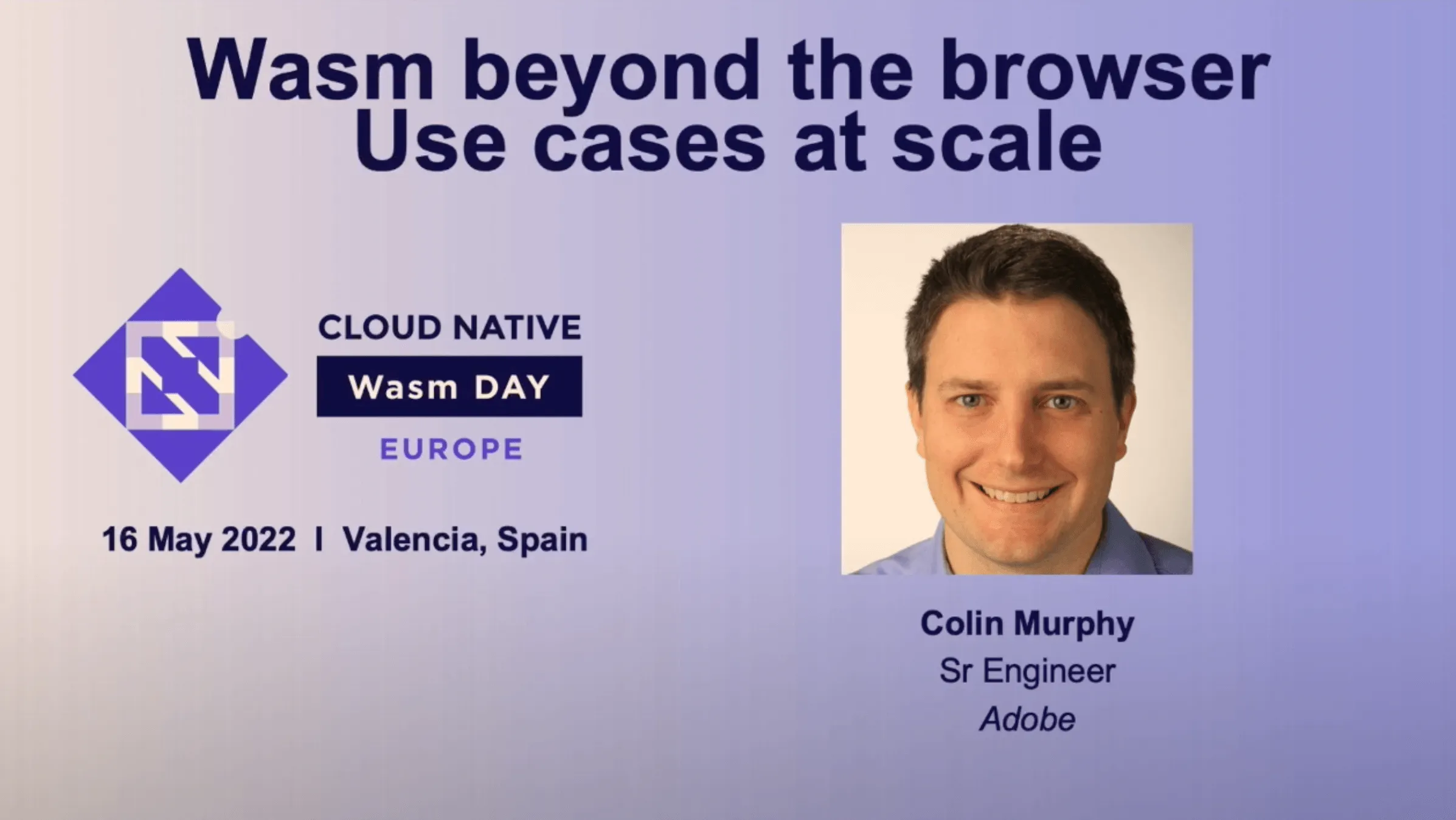
Wasm Beyond the Browser: Use Cases at Scale
During Cloud Native Wasm Day, Adobe’s Colin Murphy talked about how Adobe is using WebAssembly within its flagship web browser-based products Photoshop, Lightroom and Acrobat. He also explored potential Wasm use cases for edge compute and in the data center with wasmCloud.

Why WebAssembly Belongs Outside the Browser
Here at Cosmonic, we believe that WebAssembly is the future. In talking to developers we found that many people still have questions about why WebAssembly would be useful for them. We partnered with our friends at Suborbital and Fermyon to write a blog post answering why we think WebAssembly is so compelling. Check out the blog post on Wasm Builders!
Low-Cost Cloud for Indie Game Developers
During WasmDay and KubeCon EU, a handful of cloud native developers demonstrated how they’re using WebAssembly and wasmCloud to simplify distributed application development and dramatically reduce their costs.
In his Lightning Talk, “wasmCloud and Bevy ECS: Solution to Woe of Indie Game Developers” Alan, Poon Yong Quan demonstrated how he’s using wasmCloud and Bevy ECS, a data-driven game engine built in Rust, to lower cloud platform costs for multi-player games.

Shrink Your Attack Surface with WebAssembly
WebAssembly is poised to fundamentally transform the development of both browser and server-side development.
The virtualization of the CPU, OS, and the cloud with hypervisors, containers, and Kubernetes each marked epochs of technology that ushered in emerging trends in software architecture, design, development, operation, and life cycle management.
KubeCon EU: Pioneering wasmCloud Use Cases
Imagine rapid development of platform-agnostic multi-cloud, multi-edge and far-edge platforms that run at near native speeds anywhere, at any scale. Fast, secure-by-default, distributed application development that eliminates entire classes of security and portability challenges at significant cost savings.
That’s the power and possibility of Cloud Native technologies and WebAssembly, a Better Together story that will take center stage in Valencia on the eve of KubeCon EU 2022.
Write the Right Code
There is a special kind of pride that comes from the exhaustion at the end of a hard day's work. Whether we spend our days laying bricks, pouring concrete, mowing lawns, cooking hamburgers, or smashing rocks; our exhaustion is proof that we've done work. The well-earned rest after all that work feels good.
What if our goal wasn't just to smash rocks, but instead to find some tiny nugget of value inside just a small fraction of the rocks? With that goal in mind, does it still make sense to spend our days smashing every rock we see with a hammer, or is there a better, more focused approach?
Running your UI on wasmCloud
One of the things we've run into as we've worked with customers and developed our own examples at
Cosmonic is the need to serve UIs that are consuming services you are running inside of wasmCloud.
Our own examples required you to either run the UI using npm or to run a docker image. This felt
less than ideal and didn't fit with our vision of WebAssembly being the future of distributed
computing.
We just released a new version of the petclinic example that demonstrates how you can bundle up a UI for your application into a single actor. Now when you start the full petclinic example, the API and UI are served from the same place
Best Practices for Wasm with Forrester Research
Forrester Research recently produced “WebAssembly Wisdom: Best Practices for Wasm Wizards” (March 15, 2022, by Andrew Cornwall with Chris Gardner, Emma Goldberg, Zachary Stone, Kara Hartig) that offered advice about what to do and what not to do when contemplating Wasm development.
As Andrew remarked in his blog, “I am confident that bytecode is back and WebAssembly is here to stay… While WebAssembly emerged from a desire to improve the performance of computationally intensive browser apps, it can do much more than that.”